
Why Slots Feel “Hot” and “Cold” - And What’s Really Happening

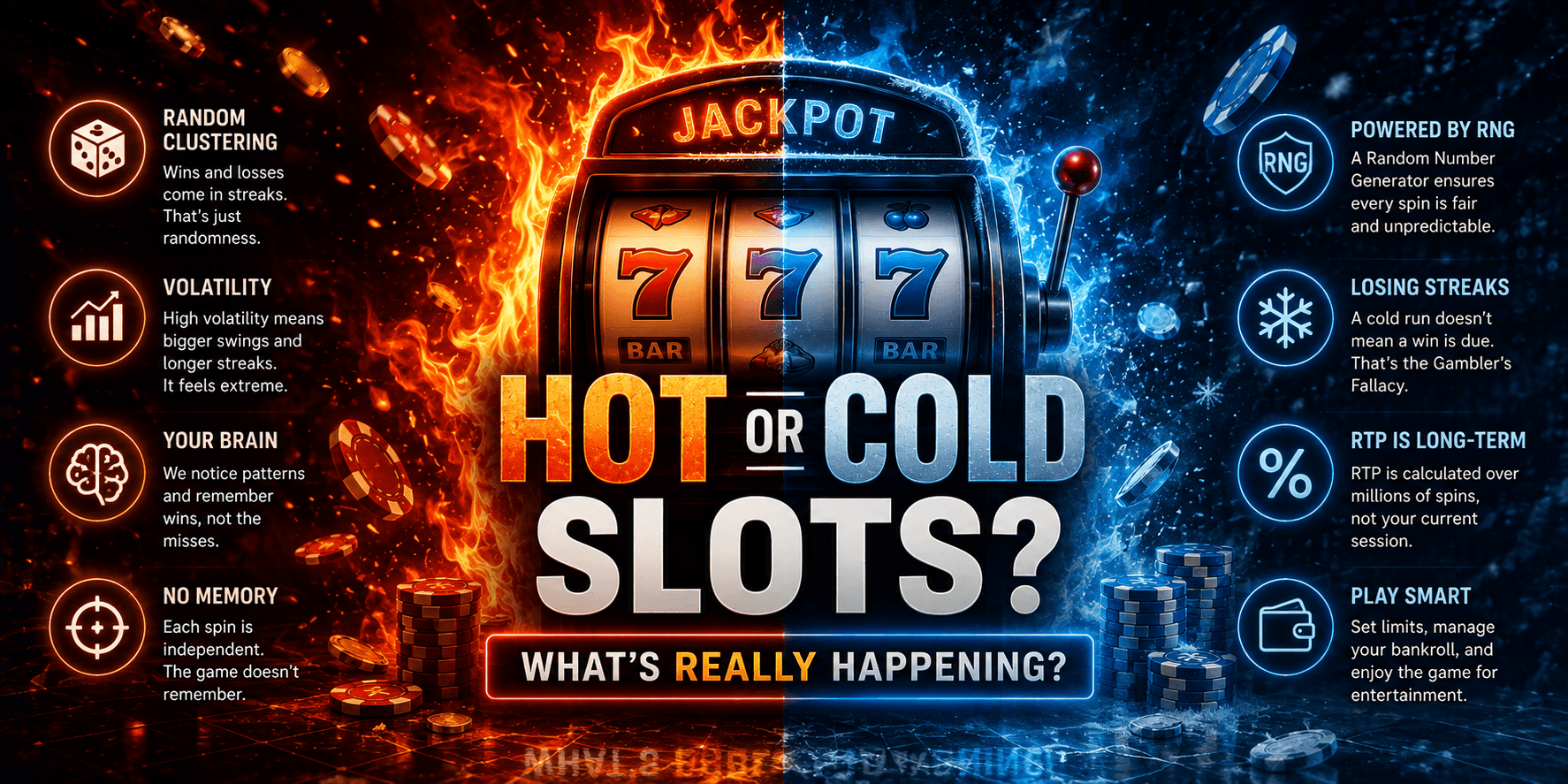
If you've played online slots for any length of time, you've probably experienced a session where a game suddenly seemed unstoppable. Bonus rounds appeared regularly, winning combinations landed one after another, and your balance kept moving in the right direction. Then, perhaps on another day—or even twenty minutes later—the exact same slot seemed completely different. Spins disappeared without meaningful wins, bonuses felt impossible to trigger, and the game appeared to have gone "cold."
It's easy to understand why players describe slots this way. When several wins arrive close together, the game genuinely feels hot, while a long sequence of unsuccessful spins can make it seem as though something has changed behind the scenes. But does a slot actually become hot or cold, or are we simply experiencing the natural behavior of randomness?
In properly implemented RNG-based casino games, the answer has much more to do with probability, volatility, and human psychology than with a machine entering some temporary winning or losing mode.
What Players Mean by a “Hot” or “Cold” Slot
A "hot" slot generally refers to a game that appears to be paying unusually frequently. Perhaps you've triggered two bonuses within a short period, landed several larger wins, or simply experienced enough smaller payouts to keep your balance climbing. A "cold" slot describes the opposite experience: extended stretches of unsuccessful spins, few meaningful combinations, and the impression that the game has stopped paying.
Those experiences are real, but the interpretation can be misleading. A series of wins doesn't necessarily mean a slot has become more generous, just as a losing streak doesn't automatically mean the game has changed its behavior. In games powered by a properly functioning Random Number Generator, each spin is generated independently according to the game's underlying mathematics.
The slot doesn't need to compensate for what happened previously, nor does it become more likely to pay simply because you've experienced a long losing sequence.
Randomness Doesn't Always Look Random
One of the strangest things about randomness is that it rarely looks as orderly as people expect. We tend to imagine genuinely random results as being evenly distributed: a few wins, a few losses, perhaps another win, followed by another loss. Actual random sequences can be far messier.
Wins can appear in clusters. So can losses. A bonus might trigger twice within fifty spins and then fail to appear for hundreds more. None of those sequences necessarily indicate that the game's underlying probabilities have changed; they're simply outcomes that can occur naturally when independent random events are repeated many times.
Think about repeatedly flipping a fair coin. Seeing heads five times consecutively may look suspicious, but it's entirely possible without anything being wrong with the coin. Slots involve far more possible outcomes than a coin toss, making their short-term behavior even more unpredictable.
This clustering is one of the main reasons slots can appear to move between "hot" and "cold" periods even when the mathematical model remains unchanged.
Volatility Makes the Effect Even Stronger
The feeling becomes especially noticeable when playing high-volatility slots. These games are typically designed so that meaningful wins can be less frequent while larger payouts remain possible, creating much more dramatic swings during individual sessions.
A high-volatility game may therefore produce an extended period where very little happens before suddenly delivering a significant win or several strong outcomes close together. From the player's perspective, it can look as though the slot suddenly "woke up." In reality, this behavior may simply be consistent with the game's volatility profile.
Lower-volatility games generally distribute returns differently, with smaller wins occurring more regularly. They can consequently feel more consistent, although that doesn't mean they're secretly running "hotter." This is why understanding volatility is often more useful than trying to determine whether a particular machine is currently paying well.
Your Brain Is Looking for Patterns Too
Casino mathematics isn't the only reason hot and cold streaks feel convincing. Human beings are exceptionally good at finding patterns—even when those patterns don't have predictive value.
Suppose you trigger a large bonus shortly after increasing your bet. It's natural to remember the connection and wonder whether the larger wager somehow caused the result. Likewise, if a slot produces several wins shortly after you start playing, you may remember it as a game that "always pays quickly."
This is closely related to confirmation bias, where we notice and remember events that support an existing belief while paying less attention to the occasions when the same supposed pattern fails.
The result can be a powerful illusion of predictability. A player may genuinely believe they've discovered when a slot becomes hot, even though the observed pattern is simply a small sample of random outcomes.
A Losing Streak Doesn't Mean a Win Is Due
The opposite belief can be even more dangerous. After a long cold streak, players sometimes assume that the slot must eventually compensate with a large payout. This is a classic example of the gambler's fallacy—the mistaken belief that previous independent outcomes change the probability of what happens next.
If a slot has produced 100 unsuccessful spins, spin number 101 isn't automatically more likely to win simply because the previous results were disappointing. The RNG doesn't remember the frustration of the player, how long the session has lasted, or how much money has already been wagered.
That doesn't mean a win can't arrive on the next spin. It absolutely can. The important distinction is that the previous losing sequence isn't what makes that win more likely.
This is also why chasing a supposedly cold machine in anticipation of an inevitable payout can quickly become expensive.
What About RTP?
RTP can create another layer of confusion because players sometimes expect a game to "catch up" with its theoretical return percentage.
Imagine a slot with a published RTP of 96%. After experiencing a poor session, a player might assume the machine needs to produce more wins soon to move back toward that figure. But as we discussed in our guide to RTP in short casino sessions, the percentage isn't a target that the game actively tries to maintain for each individual player.
RTP describes theoretical performance over an enormous number of rounds. A single session can finish dramatically above or below that percentage without anything unusual happening.
The game doesn't monitor your personal return and adjust future outcomes to bring you closer to 96%.
Can You Use Hot and Cold Streaks as a Strategy?
This is where the distinction between observation and prediction becomes important. You can certainly observe that you've just experienced an unusually strong or weak sequence of results, but that information doesn't necessarily tell you what will happen next.
Leaving a game after a certain loss limit, taking a break after a long session, or protecting part of a large win can all be sensible bankroll decisions. What those choices cannot do is identify whether the RNG is about to enter a profitable phase.
A hot streak describes what has happened. It doesn't reliably predict what will happen.
That difference may sound small, but it's one of the most important ideas to understand when playing games based on independent random outcomes.
Final Thoughts
Slots can absolutely feel hot and cold because short-term casino results are rarely smooth. Randomness naturally produces clusters, volatility creates dramatic swings, and the human brain is constantly searching for patterns that might explain what we're experiencing.
What those streaks don't provide is a reliable window into the next spin. In properly implemented RNG-based games, previous wins and losses don't instruct the game to become more generous or more restrictive, and a long losing sequence doesn't create a mathematical debt that must eventually be repaid.
Understanding that doesn't make slot games predictable—quite the opposite. It helps explain why they are inherently unpredictable in the first place.
The next time a slot appears to be running hot or ice cold, the most useful question may not be whether the game has changed. It may simply be whether you're seeing randomness behave exactly as randomness sometimes does.