
RTP vs Volatility: What's the Difference in Crypto Casino Games?

If you've spent any time researching online slots or crypto casino games, you've probably come across two terms that appear again and again: RTP and volatility.
For many players, they seem interchangeable. After all, both are used to describe how a game behaves and how likely it is to pay out.
In reality, they measure two completely different things.
Understanding the difference between RTP and volatility can help players choose games that better match their playing style, bankroll, and expectations. It's also one of the simplest ways to become a more informed crypto casino player.
What Is RTP?
RTP stands for Return to Player.
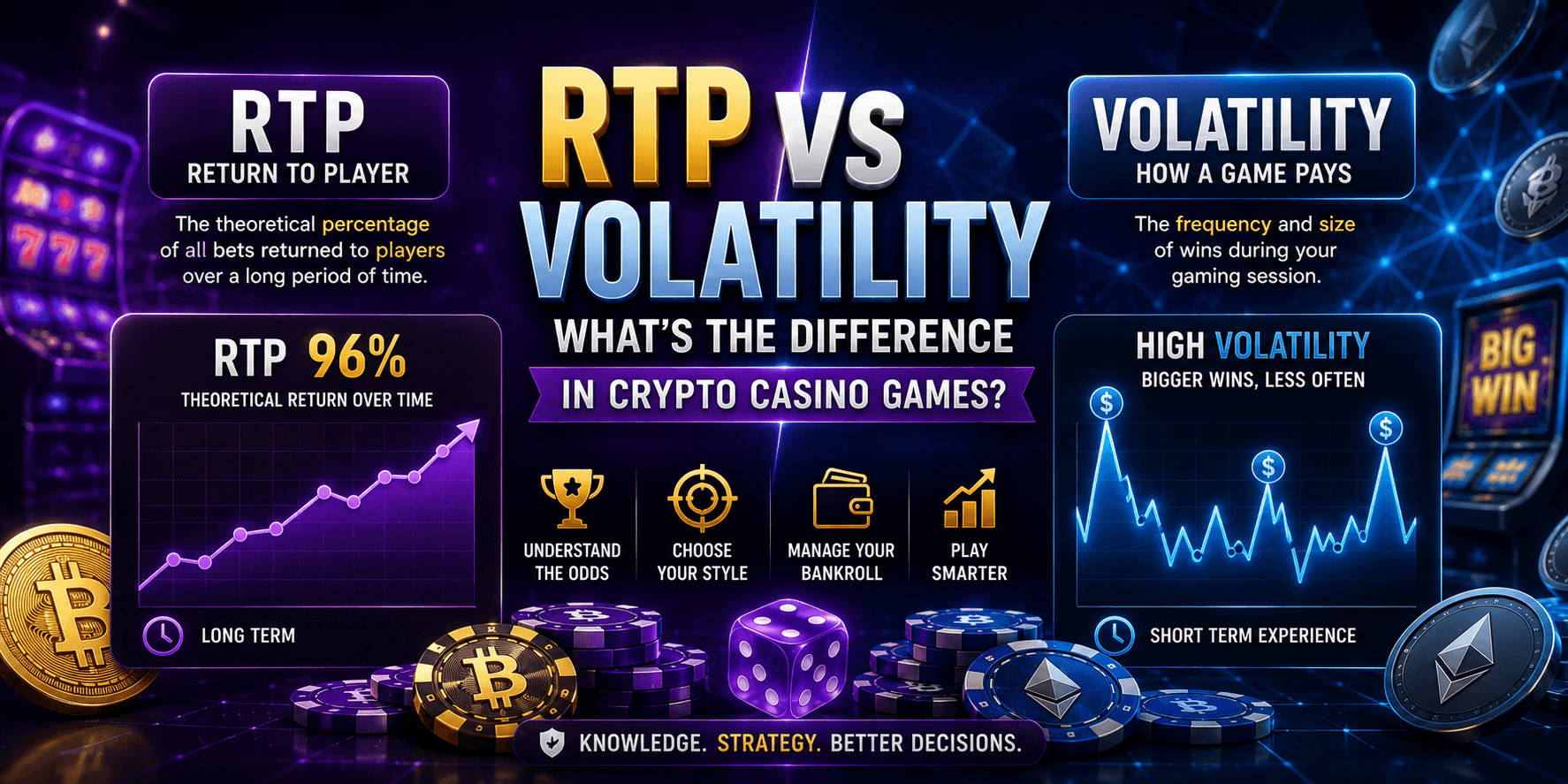
It represents the theoretical percentage of all wagered money that a game is expected to return to players over an extremely long period of time.
For example, if a slot has an RTP of 96%, it means that, statistically, the game is designed to return $96 for every $100 wagered across millions of spins.
That doesn't mean every player will receive exactly 96% of their money back.
Some players may experience significant wins, while others may lose more than expected. RTP is a long-term mathematical average, not a prediction of what will happen during a single gaming session.
What Is Volatility?
Volatility describes how a game pays, not how much it pays over time.
A low-volatility game tends to produce smaller wins more frequently. Players often experience steady gameplay with fewer dramatic swings in their bankroll.
A high-volatility game works differently. Wins may be much less frequent, but when they do occur, they can be significantly larger.
This is why two games with exactly the same RTP can feel completely different to play.
Volatility shapes the experience, while RTP describes the long-term mathematical expectation.
Why Players Often Confuse the Two
At first glance, RTP and volatility seem closely connected because both influence winnings.
However, they answer different questions.
RTP asks:
"How much is this game expected to return over millions of rounds?"
Volatility asks:
"What is the journey likely to feel like while I'm playing?"
Imagine two slot games with an RTP of 96%.
One may deliver regular small wins that keep your balance relatively stable. The other may produce long losing streaks before eventually awarding a much larger payout.
The RTP is identical.
The player experience is completely different.
Which Is More Important?
There isn't a universal answer because it depends on the player.
Someone looking for longer gaming sessions may prefer lower-volatility games, where frequent smaller wins help extend gameplay.
Other players enjoy chasing larger payouts and are comfortable with greater risk. They often choose high-volatility games despite knowing they may experience longer periods without significant wins.
Understanding your own playing style is often more important than focusing on a single statistic.
Why Crypto Casino Players Should Understand Both
Crypto gambling introduces another variable that traditional casino players don't always consider: market volatility.
Imagine playing a high-volatility slot using Bitcoin during a period of rapid price movement.
Your bankroll may fluctuate not only because of the game's volatility but also because the value of Bitcoin itself is changing.
This creates two separate layers of volatility operating at the same time.
Many experienced crypto casino players reduce this effect by using stablecoins, allowing them to focus on the game's behavior rather than cryptocurrency price movements.
RTP Doesn't Guarantee Short-Term Results
One of the biggest misconceptions among beginners is believing that a high RTP guarantees better short-term outcomes.
Unfortunately, that's not how probability works.
A game with a 97% RTP can still produce losing sessions, just as a lower-RTP game can occasionally generate very large wins.
Because RTP is calculated over millions of rounds, short-term results can vary dramatically from the mathematical expectation.
This is one reason responsible bankroll management remains important regardless of the game's published RTP.
Choosing Games That Match Your Style
Rather than asking which games are "best," experienced players often ask which games fit their goals.
If the objective is entertainment over a longer period, lower-volatility games may provide a steadier experience.
If the excitement comes from chasing larger payouts, higher-volatility games may be more appealing, provided players understand the increased risk involved.
Neither approach is inherently better.
The key is understanding the trade-off before placing the first bet.
Why This Matters When Reading Casino Reviews
Casino reviews often highlight game libraries but rarely explain the types of games available.
A platform offering hundreds of high-volatility slots may appeal to one type of player while being completely unsuitable for another.
That's why evaluating a casino isn't just about the number of games—it also involves understanding the variety of experiences those games provide.
Knowing the difference between RTP and volatility allows players to look beyond marketing and make more informed choices.
Final Thoughts
RTP and volatility are two of the most important concepts in online gambling, yet they're often misunderstood.
RTP measures the long-term percentage a game is designed to return, while volatility describes how those returns are likely to be distributed during play.
Neither statistic tells the full story on its own.
By understanding both, players can choose games that better match their expectations, manage their bankroll more effectively, and enjoy a more informed crypto casino experience.
Knowledge won't change the odds—but it can help players make smarter decisions.