
Hit Frequency vs RTP: What’s the Difference?

When comparing online slots, players tend to focus on one number above everything else: RTP. A game offering 97% RTP naturally looks more attractive than one returning 95.5%, at least on paper. But RTP only tells part of the story, and another statistic can have a major influence on how a slot actually feels when you play it: hit frequency.
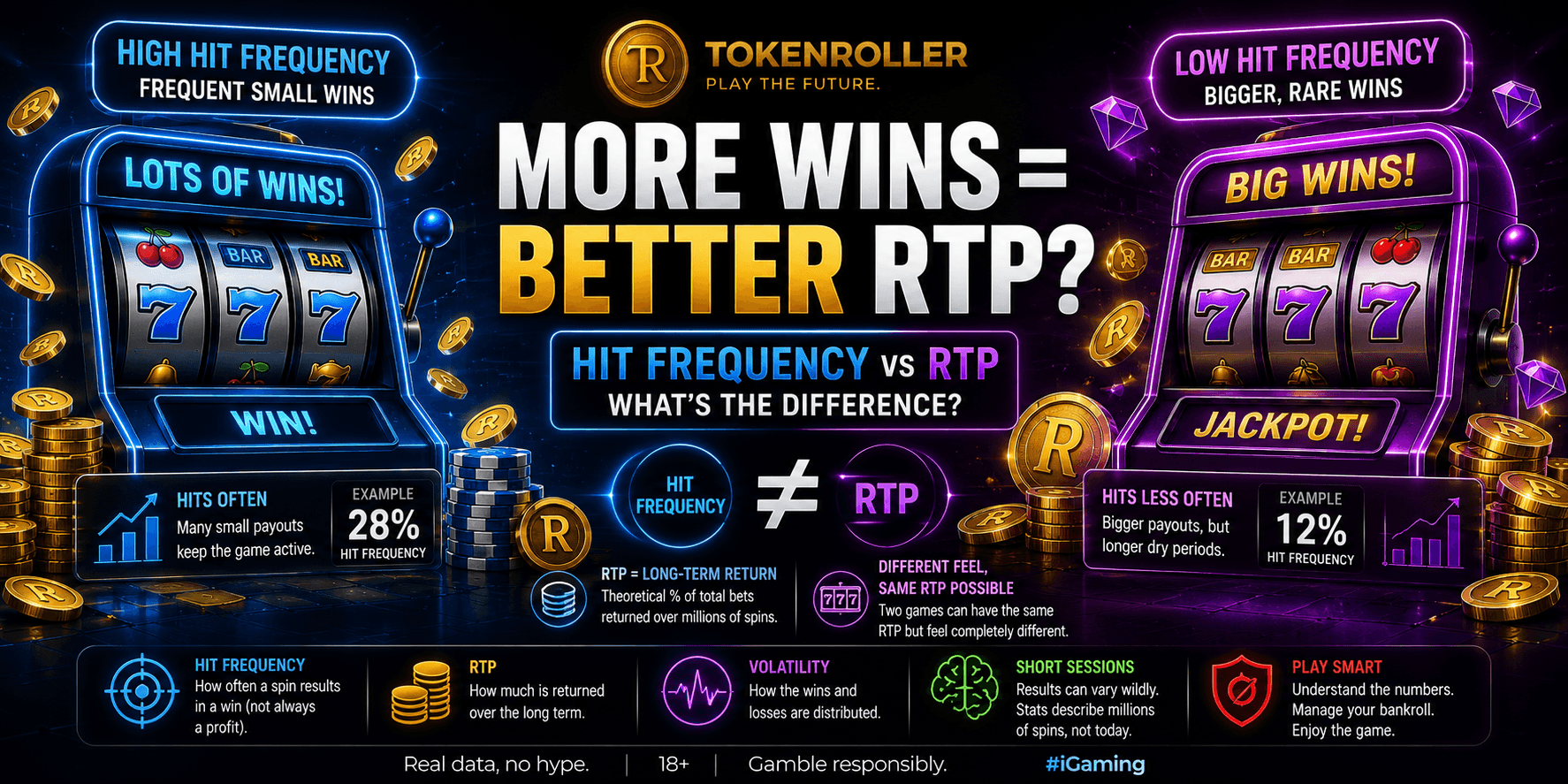
The two concepts are easy to confuse because both relate to payouts, but they measure completely different things. RTP estimates how much of all wagered money a game is theoretically designed to return over a very large number of rounds, while hit frequency describes how often a spin produces an outcome classified as a win. A slot can therefore have a high hit frequency without having an especially high RTP, and another can produce fewer winning spins while still offering a better theoretical return.
Understanding that distinction can make slot statistics much more useful, particularly when comparing games that appear similar on the surface.
What Is Hit Frequency?
Hit frequency, sometimes called hit rate, generally represents the percentage of game rounds that produce a winning outcome according to the rules of the slot. If a game has a theoretical hit frequency of 25%, for example, that suggests roughly one in four spins will result in some form of winning combination over a sufficiently large sample.
That does not mean players should expect a win exactly every fourth spin. Random outcomes don't arrive according to a schedule, so several wins can occur close together before a much longer losing sequence appears. Just like RTP, hit frequency becomes more meaningful across large numbers of rounds rather than a single short session.
There is another detail that often surprises new players: a winning spin isn't necessarily a profitable spin. If you wager $1 and receive a $0.40 payout, the game may technically record a winning combination even though your balance has still fallen by $0.60. This is one reason why a slot that appears to "hit" regularly isn't automatically returning more money to the player.
RTP Answers a Different Question
RTP, or Return to Player, focuses on the theoretical value returned rather than how frequently individual wins occur. A 96% RTP means that, according to the game's mathematical model, approximately $96 is theoretically returned for every $100 wagered across an enormous number of rounds. It does not mean an individual player who wagers $100 should expect to leave with $96.
This long-term nature of RTP is important because short casino sessions can finish almost anywhere relative to the theoretical percentage. One player might experience a large bonus and finish dramatically above the game's RTP, while another could lose most of their bankroll despite playing exactly the same slot.
Hit frequency doesn't solve that unpredictability. It simply gives players another piece of information about how the game's payouts may be structured.
High Hit Frequency Doesn't Automatically Mean High RTP
Imagine two hypothetical slots. Game A produces winning combinations relatively frequently, but many of those wins are small. Game B pays less often but occasionally delivers substantially larger prizes. Both games could theoretically have an identical RTP despite providing completely different playing experiences.
Game A might feel active because something appears to happen regularly. Your balance could fluctuate gradually as small payouts arrive throughout the session. Game B might feel much harsher, with longer stretches where little happens before a significant win suddenly changes the balance.
Neither payout pattern tells you the RTP by itself.
This is why choosing a game simply because it appears to pay frequently can be misleading. Frequency describes how often certain outcomes occur, while RTP takes the value of those outcomes into account over the long term.
Where Does Volatility Fit In?
The distinction becomes even more useful when we introduce volatility, another statistic that players often mix up with hit frequency.
Volatility broadly describes the level and distribution of risk within a game. High-volatility slots tend to produce more dramatic bankroll swings, often combining periods of limited returns with the possibility of much larger payouts. Lower-volatility games typically create a steadier experience with less extreme movement.
Hit frequency and volatility can influence one another, but they aren't interchangeable. Two slots could theoretically have similar hit frequencies while distributing the value of their wins very differently, which would make their volatility profiles feel completely different.
A simple way to remember the three concepts is that RTP describes theoretical long-term return, hit frequency describes how often winning outcomes occur, and volatility helps describe how unevenly the financial results can be distributed.
Together, they provide a much more useful picture than any one statistic on its own.
Why Small Wins Can Be Misleading
Modern slots often contain frequent low-value combinations, free-spin triggers, bonus mechanics and other events designed to keep the game visually active. As a result, players can experience plenty of celebratory animations without necessarily increasing their bankroll.
Suppose you're wagering $2 per spin and receive a $0.80 payout. The screen may flash, sounds may play and the game may record a winning result, but financially you've still lost $1.20 on that round.
This is sometimes described as a loss disguised as a win, and it demonstrates why hit frequency shouldn't be interpreted as the percentage of spins that generate a net profit. The exact way wins are counted can depend on the game's design and the statistic being reported, so players should check the provider's information rather than assuming every published hit-rate figure is calculated identically.
Can Hit Frequency Predict Your Next Session?
Like RTP, hit frequency is a theoretical statistic rather than a timetable.
A game with a 30% hit frequency doesn't guarantee exactly 30 winning results from your next 100 spins. You could experience considerably more or considerably fewer because short-term results are dominated by randomness.
This connects directly with why slots sometimes appear hot or cold. If several winning outcomes happen close together, the game may feel unusually generous. If randomness produces a long gap between hits, players can easily conclude that something has changed. Neither observation necessarily tells us anything about what the next spin will produce.
The statistics describe the mathematical structure of the game; they don't remove the uncertainty of individual outcomes.
Which Statistic Should Players Care About?
There isn't a single number that tells you whether a slot is "good." RTP is useful for comparing theoretical long-term returns, while hit frequency can provide additional context about how regularly winning combinations may occur. Volatility adds another layer by helping players understand the type of swings they might experience.
For someone who prefers frequent activity and smaller payouts, a game with a higher hit frequency may feel more enjoyable even if another slot offers a slightly higher RTP. A player comfortable with longer dry periods in exchange for the possibility of larger wins may prefer a completely different mathematical profile.
The important point is to understand what each statistic actually measures instead of treating every percentage as another version of RTP.
Final Thoughts
Hit frequency and RTP both describe important parts of a slot's mathematics, but they answer different questions. RTP is about theoretical value returned over the long term, while hit frequency is about how often winning outcomes occur. Neither statistic can tell you exactly what will happen during your next session.
A slot can hit frequently while returning relatively small amounts, just as another can produce fewer wins while concentrating more of its theoretical return into larger payouts. Add volatility to the equation, and it becomes clear why games with similar RTP percentages can provide radically different experiences.
Understanding these differences won't make the next spin predictable, but it does make the numbers displayed beside a casino game far more meaningful. Instead of asking which statistic is best, players can use RTP, hit frequency and volatility together to understand what kind of game they're actually choosing.