
Expected Value (EV) Explained for Crypto Casino Players

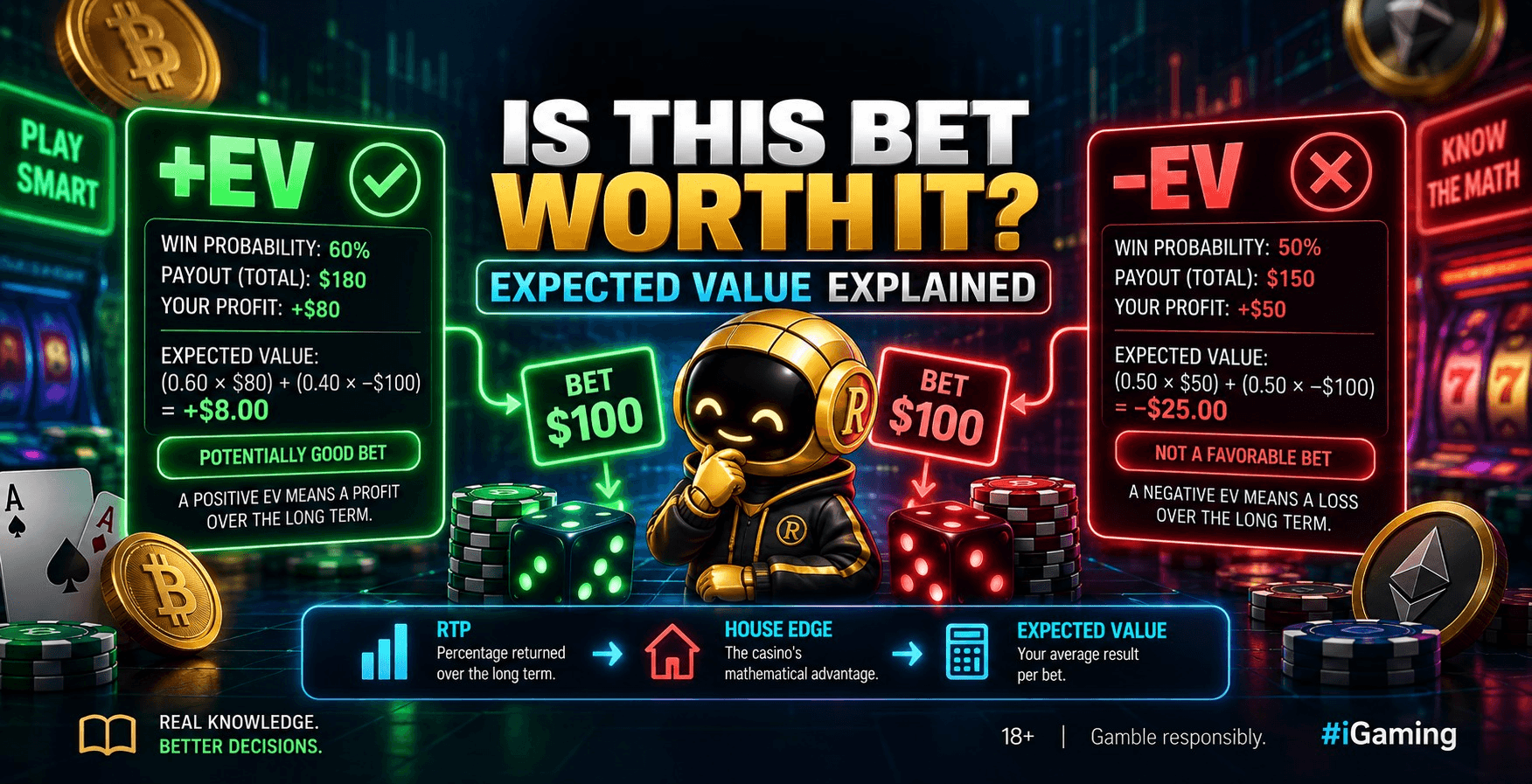
Casino games are built around probability, but probability alone doesn't tell you whether a wager is mathematically favorable. A bet might give you a 50% chance of winning and still be a poor proposition if the payout doesn't adequately compensate for the money you risk. Another opportunity might win far less frequently but offer a sufficiently large reward to make the mathematics more attractive. This is where Expected Value, usually shortened to EV, becomes useful.
Expected Value estimates the average mathematical result of a wager if the same situation could be repeated many times under identical conditions. It doesn't predict whether your next bet will win or lose, and it certainly doesn't guarantee what will happen during a single casino session. Instead, EV gives you a way to compare the probability of each possible outcome with the amount you stand to gain or lose.
For crypto casino players, understanding EV can make concepts such as RTP, house edge and bonus value much easier to interpret. It also helps separate an exciting-looking payout from a wager that is actually favorable—or unfavorable—on paper.
What Is Expected Value?
At its simplest, Expected Value asks one question: if I could make this exact bet repeatedly, what would my average result eventually look like?
Consider a hypothetical $10 wager with a 50% chance of winning. When you win, you receive $19 in total, meaning your net profit is $9. When you lose, you lose the entire $10 stake.
The calculation looks like this:
EV = (0.50 × $9) + (0.50 × −$10)
That gives us:
EV = $4.50 − $5.00 = −$0.50
The Expected Value of the wager is therefore −$0.50. This doesn't mean you'll lose exactly fifty cents when you place the bet. You'll either make a $9 profit or lose $10 in our simplified example. The −$0.50 figure describes the theoretical average result if that same opportunity were repeated an enormous number of times.
This distinction between individual outcomes and long-term expectation is fundamental to understanding casino mathematics.
Positive EV vs Negative EV
Expected Value can be positive, negative or theoretically neutral. A positive-EV (+EV) opportunity has a mathematical average above zero, while a negative-EV (−EV) opportunity has an average below zero. An EV of exactly zero would represent a mathematically neutral proposition before considering other costs.
Most standard casino games are intentionally structured as negative-EV wagers for the player because the payouts are slightly lower than mathematically fair odds would require. That difference is what allows the casino to maintain its long-term advantage.
But negative EV doesn't mean every player loses every session. A player can place a negative-EV bet and win immediately, just as someone can encounter a theoretically positive-EV opportunity and still lose. EV describes the average economics of the opportunity rather than the result of one attempt.
That's why screenshots of huge casino wins tell you very little about whether the underlying wager was mathematically favorable.
How EV Connects to House Edge
Expected Value and house edge describe closely related ideas from slightly different perspectives.
Suppose a casino game has a theoretical house edge of 4%. If you wager $100 under the same mathematical conditions, the player's theoretical expected loss is approximately $4:
$100 × 4% = $4
From the player's perspective, the EV associated with that $100 of wagering would therefore be approximately:
EV = −$4
Scale the amount to $1,000 of total wagering and the theoretical expectation becomes approximately −$40, assuming the same house edge and ignoring complications such as changing rules or promotions.
This doesn't mean you'll lose exactly $40 after wagering $1,000. You could finish considerably ahead or lose substantially more. The figure represents the mathematical expectation, while actual short-term results can vary enormously.
EV and RTP Are Closely Related Too
RTP provides another way of viewing essentially the same underlying economics.
Consider a theoretical game with:
96% RTP
The corresponding theoretical house edge would generally be:
100% − 96% = 4%
For every $100 wagered, that implies an expected player result of approximately:
−$4
RTP describes the proportion theoretically returned to players over the long term, house edge describes the casino's theoretical advantage, and EV translates the probabilities and payouts into an expected monetary result for a particular wager or set of wagers.
Understanding all three gives you a much clearer picture than looking at any one number in isolation.
Why Your Actual Session Can Look Nothing Like the EV
This is where Expected Value is commonly misunderstood.
Imagine a game where your EV is −$1 for every $100 wagered. You shouldn't expect your balance to decline smoothly by exactly one dollar every time you wager another hundred. Real casino outcomes don't behave that neatly.
You might win $300 during one session, lose $500 during another and experience relatively small changes during the next. Volatility and randomness dominate short-term results, while EV becomes increasingly meaningful as the number of repeated wagers grows.
This is similar to the way RTP works. A 96% RTP doesn't promise that you'll receive $96 after wagering $100, and an EV of −$4 doesn't mean the casino will simply remove four dollars from every hundred you wager.
Mathematical expectation and short-term experience are different things.
Can Casino Bonuses Change Expected Value?
This is where EV becomes particularly interesting.
Casino promotions can add value to a gambling proposition. Deposit bonuses, free spins, cashback, loss rebates and other rewards can theoretically offset some of the house edge. Under certain conditions, a promotion can substantially change the economics of an offer.
But the headline bonus percentage isn't enough to determine its value.
Imagine two casinos offering the same 100% deposit bonus. One may require relatively manageable wagering before funds become withdrawable, while the other could impose much higher wagering requirements, restrictive game contributions, maximum-bet rules, withdrawal caps or other conditions.
The bonuses look identical in an advertisement but may have dramatically different mathematical value.
This is why reading the terms matters. The real question isn't simply “How big is the bonus?” It's “What is this bonus worth after accounting for everything I must wager and all the restrictions attached to it?”
We'll explore that calculation separately in our guide to evaluating the real value of crypto casino bonuses.
Can Betting Systems Turn Negative EV Positive?
Betting systems often change the size or sequence of wagers according to previous results. Martingale is perhaps the most famous example, where the stake increases after a loss in an attempt to recover previous losses when a win eventually occurs.
What these systems don't automatically change is the mathematics of the underlying wager.
If each individual bet has negative expected value, rearranging the size and timing of those bets doesn't magically remove the casino's advantage. The system can dramatically change the distribution of results—you might experience many small winning sequences followed by a much larger loss—but that isn't the same as creating positive EV.
This connects directly with our previous discussions about chasing losses and increasing bet sizes. Changing your exposure is not necessarily the same as changing your odds.
What About Provably Fair Games?
Provably Fair technology doesn't automatically create positive EV either.
A crypto casino can offer a game where every result can be independently verified and still maintain a house edge through its payout structure. Provable fairness relates to whether the outcome-generation process can be checked; Expected Value relates to the mathematics of the wager itself.
A game can therefore be transparent, unpredictable and negative EV at exactly the same time.
This distinction is important because players sometimes assume that "fair" means a 50/50 financial proposition. In casino terminology, those concepts shouldn't be treated as interchangeable.
Crypto Adds Another Kind of Risk
Crypto casino players also need to separate casino EV from cryptocurrency price movement.
Suppose you win 0.001 BTC. The casino wager has already produced its result, but the fiat value of that Bitcoin can continue changing after you withdraw it. If Bitcoin rises substantially, the value of your winnings increases in fiat terms; if Bitcoin falls, it decreases.
That market movement doesn't retroactively change the Expected Value of the original casino game.
They're two different forms of exposure: gambling risk comes from the probabilities and payouts of the casino wager, while market risk comes from changes in the price of the cryptocurrency you hold.
This distinction becomes especially relevant for players who keep substantial balances denominated in volatile cryptocurrencies rather than stablecoins.
Does EV Tell You Which Casino Game Will Win?
No—and this is one of the most important limitations to understand.
Expected Value isn't a prediction tool.
If Game A has slightly better EV than Game B, that doesn't mean Game A will produce the better result during your next twenty spins. It means the underlying mathematical proposition is theoretically more favorable when considered across repeated wagers.
EV helps evaluate the quality of a bet, not predict the outcome of a bet.
That's why it works alongside concepts such as RTP, volatility and hit frequency rather than replacing them. Each statistic answers a different question about the game.
Why EV Matters for Crypto Casino Players
You don't need to calculate Expected Value before every casino wager. In many standard casino games, the operator or provider already publishes enough information—such as RTP and game rules—to understand that the underlying proposition carries a house edge.
The real value of EV is conceptual.
It teaches you to stop asking only “How much can I win?” and start asking “What am I risking, what can I receive, and how likely is each outcome?”
That mindset is particularly useful when evaluating bonuses, comparing different wagers or encountering systems that claim to have discovered a guaranteed gambling strategy.
Large potential payouts can look impressive. EV forces probability back into the equation.
Final Thoughts
Expected Value is one of the most useful concepts for understanding why casino games can produce spectacular short-term wins while still maintaining a mathematical advantage over the long term.
A negative-EV wager can win. A positive-EV opportunity can lose. Neither individual result changes the underlying mathematics.
RTP tells you the theoretical percentage returned over time. House edge expresses the casino's theoretical advantage. Expected Value takes the probabilities and payouts involved and translates them into an average mathematical result.
For crypto casino players, there's an additional distinction worth remembering: the Expected Value of the wager and the future market value of the cryptocurrency are separate things.
Understanding EV won't tell you what happens next.
What it can tell you is something arguably more useful: whether the opportunity in front of you makes mathematical sense in the first place.