
Does RTP Really Matter in Short Casino Sessions?

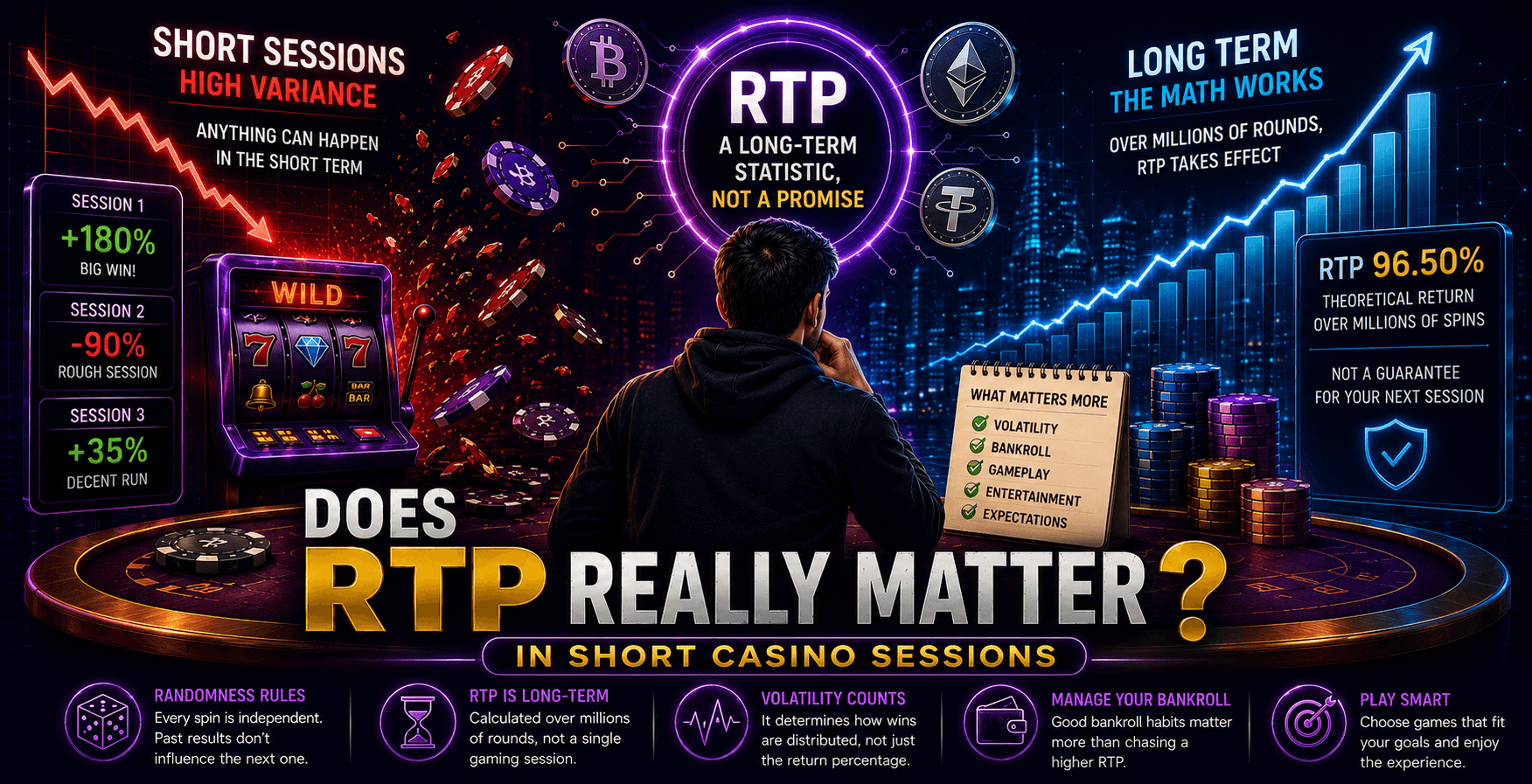
If you've ever compared online slot games, you've almost certainly noticed the RTP percentage displayed alongside the game's information. Some slots advertise a 96% RTP, while others may offer 97% or even slightly higher. At first glance, it seems obvious that choosing the game with the highest RTP should lead to better results.
In practice, it rarely works that way.
One of the biggest misconceptions in online gambling is believing that RTP predicts what will happen during your next session. Many players assume that if they wager $100 on a game with a 96% RTP, they should expect to finish with around $96. Others believe that switching to a slot with a slightly higher RTP will noticeably improve their chances of winning.
The truth is much more complicated. RTP is an important statistic, but it only becomes meaningful over an enormous number of game rounds. During the short sessions that most players actually have, randomness plays a much bigger role than the theoretical return percentage.
RTP Measures the Long Run, Not Tonight's Session
RTP, or Return to Player, represents the theoretical percentage of all wagered money that a game is expected to return over millions of spins or hands.
The key phrase here is over millions of rounds.
Imagine two players sitting down to play the exact same slot. Both choose a game with a 96% RTP and both start with identical bankrolls. After an hour, one player may have doubled their balance thanks to a bonus feature, while the other may have lost almost everything. Although their experiences are completely different, neither outcome contradicts the game's published RTP.
That's because RTP isn't designed to predict short-term results. Instead, it describes how the game behaves statistically across an enormous sample size, where random fluctuations gradually begin to balance out.
Randomness Dominates Short Sessions
Most casino sessions are surprisingly short.
Some players spin a slot for twenty minutes during a lunch break. Others might enjoy an hour of blackjack or a few hundred slot spins in the evening. From a mathematical perspective, these sessions represent only a tiny fraction of the number of rounds required for RTP to become statistically meaningful.
This is where the Random Number Generator (RNG) takes over.
Every spin is generated independently, with no memory of previous outcomes. A game doesn't know whether you've just won a jackpot or experienced fifty losing spins in a row. Each result is determined at the exact moment you press the button, making short-term outcomes largely a matter of probability rather than long-term averages.
That unpredictability is precisely what makes casino games exciting—but it's also why RTP shouldn't be treated as a guarantee.
Volatility Often Has a Bigger Impact
If you've already read our guide on RTP vs Volatility, you'll know that these two concepts describe completely different aspects of a game.
RTP tells you how much money the game is theoretically designed to return over time.
Volatility describes how those returns are likely to be distributed.
A high-volatility slot may go hundreds of spins without a significant win before suddenly awarding a large payout. A low-volatility game, on the other hand, tends to deliver smaller but more frequent wins.
This means two games with identical RTP values can feel completely different during a one-hour session. In fact, volatility usually has a much greater influence on the player's experience than a small RTP difference.
Is a Higher RTP Always Better?
In theory, yes.
Given enough time, a game with a 97% RTP is mathematically more favorable than one with a 95% RTP.
However, players often overestimate what those numbers actually mean.
The difference between two slots with RTP values of 96.2% and 96.8% is relatively small when viewed over a single evening of play. Variance can easily outweigh that difference, meaning the lower-RTP game could produce the better result during your session simply because randomness happened to work in your favor.
This doesn't make RTP meaningless—it simply highlights its intended purpose. It's a long-term comparison tool rather than a prediction of tonight's outcome.
Why Casinos Publish RTP
If RTP can't predict short-term results, why do casinos publish it at all?
The answer is transparency.
Publishing RTP allows players to compare games using a standardized mathematical metric. It provides insight into the theoretical return of one game versus another, helping players make more informed choices over the long run.
Without RTP, players would have little objective information about how different games are designed.
Many regulated casinos also work with software providers whose games are independently tested to ensure the published RTP matches the game's mathematical model.
What Players Should Focus on Instead
While RTP is useful, it shouldn't be the only factor when choosing a game.
Volatility, bankroll size, game mechanics, bonus features, and personal entertainment preferences often have a much greater influence on whether a session feels enjoyable.
A player looking for longer sessions with steadier gameplay may prefer lower-volatility slots, even if another game offers a marginally higher RTP. Someone chasing larger payouts might willingly accept more volatility, understanding that long losing streaks are part of the experience.
The best choice isn't always the game with the highest percentage. It's the one that matches your goals and expectations.
Understanding RTP Leads to Better Decisions
One of the biggest advantages of learning about RTP is that it helps players develop realistic expectations.
Instead of assuming that every session should closely reflect the published percentage, informed players understand that randomness dominates the short term while mathematics governs the long term.
That perspective makes it easier to accept both winning and losing sessions without falling into common gambling myths, such as believing a game is "due" to pay or assuming a higher RTP guarantees immediate success.
Knowledge doesn't influence the next spin—but it does influence how players interpret the outcome.
Final Thoughts
RTP remains one of the most valuable statistics in online gambling, but only when it's understood in the right context.
It isn't a promise, a prediction, or a guarantee of what will happen during your next session. Instead, it's a long-term mathematical measure designed to describe how a game behaves over millions of rounds.
For most players, short sessions are shaped far more by randomness and volatility than by small differences in RTP. Understanding that distinction leads to better decisions, more realistic expectations, and ultimately a more informed approach to crypto casino gaming.