
Crypto Casino Myths Debunked: 7 Things Players Still Get Wrong

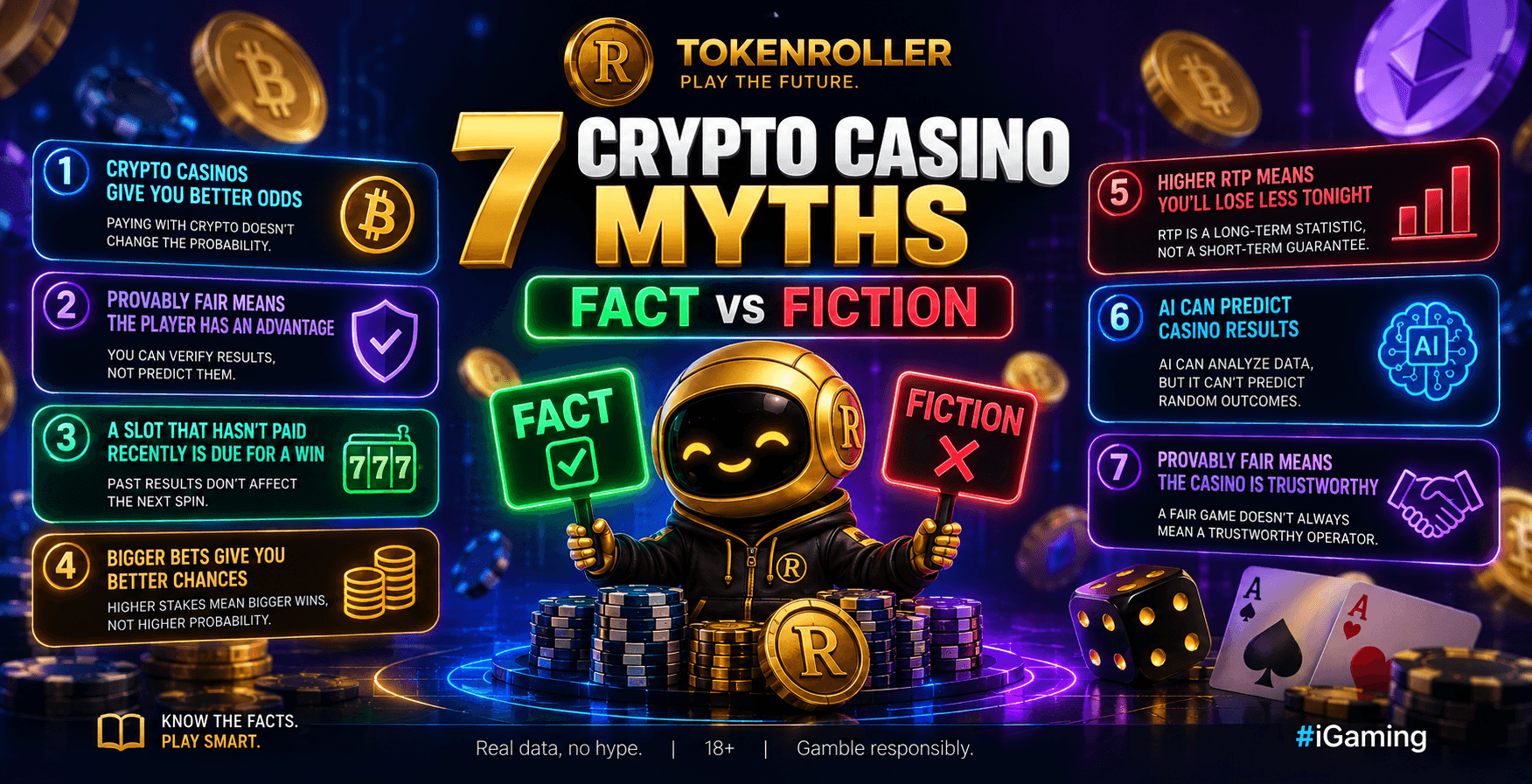
Crypto casinos have changed online gambling in some genuinely important ways. Players can fund accounts with digital assets, move money without relying exclusively on traditional banking systems, and—in some games—use cryptographic tools to independently verify results. These features have made crypto gambling faster, more transparent in certain areas, and fundamentally different from the traditional online casino experience.
But cryptocurrency hasn't rewritten probability.
Many of the beliefs surrounding crypto casinos are actually old gambling myths wearing new technological clothing. Bitcoin doesn't make a slot more generous, blockchain technology doesn't remove the house edge, and a Provably Fair badge doesn't automatically make an entire casino trustworthy. Add artificial intelligence, betting systems and misunderstandings about RTP to the mix, and it's easy to see why players encounter so much conflicting information.
Here are seven crypto casino myths that deserve a closer look.
Myth #1: Crypto Casinos Give You Better Odds
Using Bitcoin, Ethereum, USDT or another cryptocurrency can change how you fund and withdraw from a casino, but the currency itself doesn't inherently change the probability of a roulette spin, dice roll or slot outcome.
If the same game operates with the same mathematical model, paying with Bitcoin instead of fiat doesn't suddenly increase its RTP or reduce its house edge. A 5% chance remains a 5% chance regardless of whether the wager is denominated in dollars, euros or cryptocurrency.
Where crypto can make a difference is around the gambling experience. Transaction speeds, fees, privacy characteristics, withdrawal procedures and available promotions can differ considerably between payment methods and operators. Some crypto-native casinos also offer games or features that aren't common at traditional casinos.
Those differences can be meaningful, but they shouldn't be confused with better underlying odds.
Myth #2: Provably Fair Means the Player Has an Advantage
Provably Fair is one of the most misunderstood terms in crypto gambling.
The technology can allow players to verify that certain game outcomes were generated using predetermined cryptographic information and weren't secretly changed after the wager was placed. Depending on the implementation, players may be able to examine server-seed commitments, client seeds, nonces and the algorithm used to produce a result.
That's a major transparency improvement—but verification isn't the same as a mathematical advantage.
A crypto dice game can be completely verifiable while still offering payouts that produce a house edge. Every result could be generated exactly as promised and the casino could still maintain its long-term mathematical advantage.
This distinction matters: Provably Fair helps answer “Was this result generated according to the stated process?” It doesn't necessarily answer “Is this wager profitable for me?”
Myth #3: A Slot That Hasn't Paid Recently Is Due for a Win
You've been playing for twenty minutes and almost nothing has happened. The bonus hasn't appeared, your balance keeps falling and the slot feels unusually cold. Eventually, the thought becomes difficult to ignore: surely it has to pay soon.
This is the classic gambler's fallacy.
In properly implemented RNG-based games where rounds are independent, previous losses don't create a debt that the next spin needs to repay. A long sequence of unsuccessful outcomes can certainly be followed by a big win, but the losing streak itself isn't what causes that win to arrive.
Randomness also tends to produce clusters. Wins can appear unusually close together, while losing outcomes can create uncomfortable dry periods. That's why slots can genuinely feel hot or cold even when their underlying mathematics haven't changed.
The dangerous part begins when that feeling becomes a prediction. Continuing to wager—or increasing the stake—because a game is supposedly "due" can turn an ordinary losing session into a much larger one.
Myth #4: Bigger Bets Give You Better Chances
A $100 wager can produce a much larger payout than a $1 wager, so it's easy to assume the larger stake must also have a greater chance of winning.
In many casino games, it doesn't.
If you're simply increasing the size of the same wager under the same rules, the probability can remain unchanged while both the potential profit and potential loss become larger. You're putting more money behind the outcome rather than necessarily purchasing a more favorable probability.
There are important exceptions. Certain progressive jackpots may have qualifying requirements, bonus bets can introduce different mechanics, and some games offer wager options with genuinely different rules or mathematical characteristics. That's why checking the paytable and game information matters.
But as a general strategy, increasing the stake shouldn't be treated as a way of convincing the RNG to produce a better result. More often, the most immediate effect is simply that your bankroll moves faster.
Myth #5: Higher RTP Means You'll Lose Less Tonight
Suppose you're choosing between two slots: one advertises 94.5% RTP and another 97%. The second game has the more favorable theoretical return, so choosing it makes mathematical sense when everything else is equal.
What it doesn't provide is a guarantee about tonight.
RTP describes theoretical return across an enormous number of rounds. Your individual session represents a tiny sample, and short-term randomness can overwhelm relatively small differences between published RTP percentages.
You could play the higher-RTP game and lose your bankroll quickly while another player wins substantially on the lower-RTP game. Neither outcome disproves the mathematics.
This is also why RTP should be considered alongside volatility and hit frequency. Games with similar RTP percentages can distribute their returns very differently, creating dramatically different experiences over short periods.
RTP is valuable information. It simply needs to be interpreted as a long-term statistic rather than a personal cashback promise.
Myth #6: AI Can Predict Casino Results
Artificial intelligence has become remarkably good at identifying patterns, processing enormous datasets and finding relationships humans might overlook. That makes the idea of an AI-powered casino predictor sound surprisingly believable.
There's just one fundamental problem: a properly implemented random casino game isn't supposed to contain a useful historical pattern that predicts the next independent result.
An AI system can analyze thousands of previous roulette spins or millions of slot outcomes and identify patterns within the historical dataset. But finding patterns after events have occurred doesn't automatically provide predictive information about the next RNG-generated outcome.
AI can still be extremely useful around gambling. It can help explain casino terminology, compare promotions, analyze terms and conditions, summarize information and teach players about probability. What it shouldn't be expected to do is magically reveal a properly protected future random result.
Claims about guaranteed "AI slot predictors," roulette bots or paid prediction groups therefore deserve serious skepticism.
Myth #7: Provably Fair Means the Casino Itself Is Trustworthy
This may be the most important misconception on the list.
A casino can offer genuinely Provably Fair games and still perform poorly in completely different areas. Cryptographic verification of game results doesn't tell you how quickly the operator processes withdrawals, whether its bonus conditions are reasonable, how disputes are handled, whether customer support is effective or what security practices exist elsewhere on the platform.
Think of Provably Fair as evidence relating to one part of the gambling process, not a universal certificate of trustworthiness.
That's why reviewing a crypto casino requires a broader approach. Game fairness matters, but so do withdrawal history, reputation, security, transparency, payment policies, terms and conditions, responsible gambling tools and the quality of the operator behind the platform.
A glowing "Provably Fair" badge should therefore be something you investigate rather than the point where your investigation ends.
Why These Myths Are So Persistent
Most gambling myths survive because they contain something that feels intuitively correct. Bigger wagers create bigger wins. Losing streaks eventually end. AI discovers patterns. Higher RTP is mathematically preferable. Provably Fair provides transparency.
All of those statements contain some truth.
The misconception appears when that truth is stretched into a conclusion the mathematics doesn't support. Bigger wins don't necessarily mean better probability. A losing streak ending doesn't mean it was mathematically required to end on the next spin. AI recognizing historical patterns doesn't mean it can predict independent random events. And cryptographic verification doesn't eliminate the house edge or prove that an operator is trustworthy in every respect.
Understanding those distinctions is far more valuable than memorizing supposed tricks for beating casino games.
Final Thoughts
Crypto casinos have introduced genuinely useful innovations to online gambling, particularly around payments and the ability to verify certain game outcomes. But blockchain technology doesn't suspend probability, and cryptocurrency doesn't turn negative-expectation casino games into guaranteed opportunities for profit.
The same fundamental principles still matter: understand the rules, distinguish short-term randomness from long-term statistics, know what RTP and house edge actually represent, and never assume that past results control what happens next.
Most importantly, evaluate claims according to evidence rather than how convincing they sound.
Crypto may have changed the infrastructure surrounding online gambling. It didn't change the mathematics underneath it.