
Can You Beat Provably Fair Casino Games?

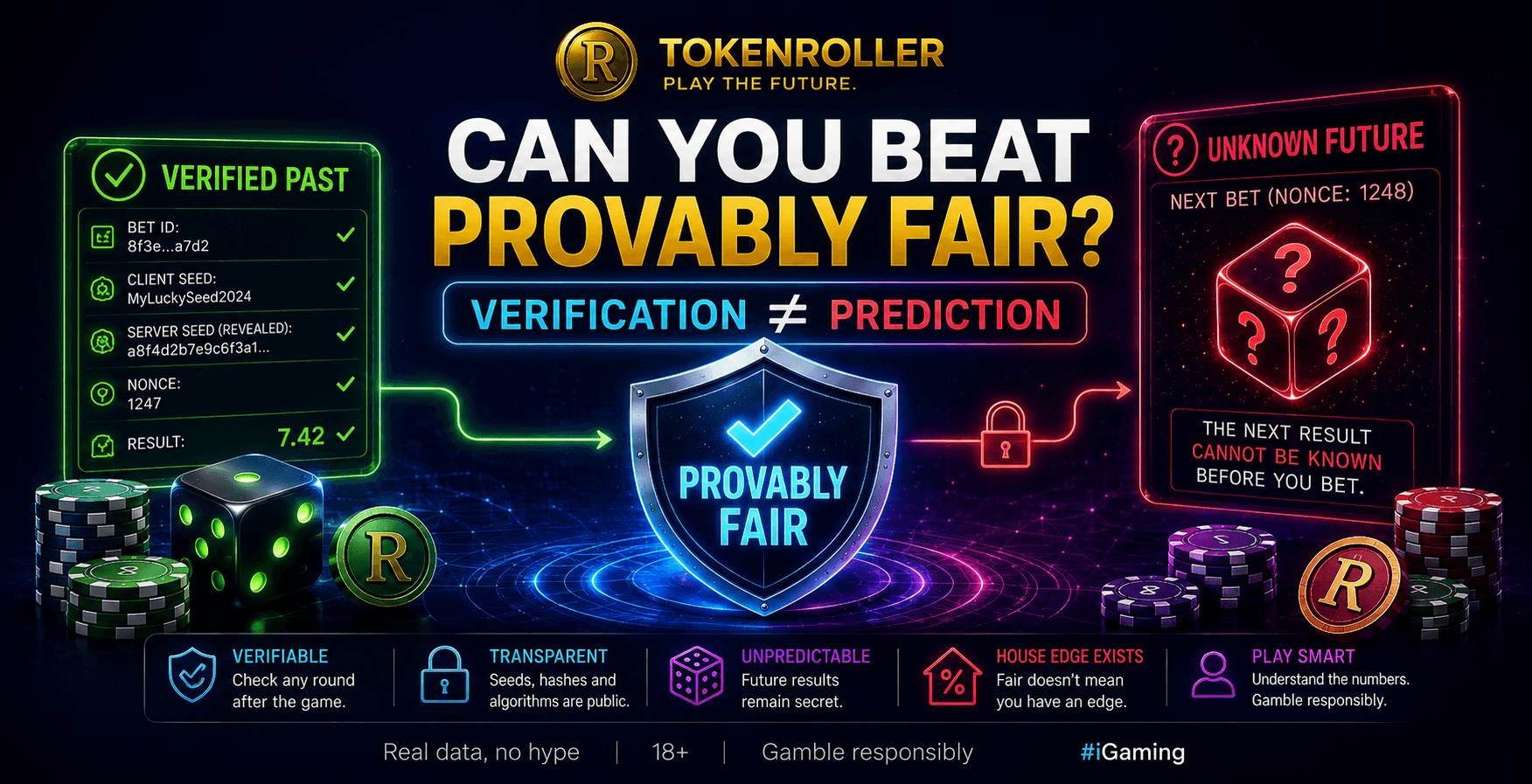
Provably Fair technology is one of the features that separates crypto casinos from traditional online gambling platforms. Instead of simply asking players to trust that a game produced an honest result, Provably Fair systems can give them the tools to independently verify that individual outcomes were generated according to predetermined cryptographic data.
That transparency naturally leads to another question. If players can inspect seeds, hashes, nonces and previous outcomes, could they eventually discover a pattern and use it to beat the game?
It sounds plausible, particularly in an industry where blockchain technology is built around transparency. But there is an important distinction at the heart of Provably Fair gambling: being able to verify an outcome is not the same as being able to predict it. A correctly implemented Provably Fair system is designed specifically to make manipulation detectable without revealing enough information to know the next result in advance.
What Provably Fair Actually Proves
The exact implementation varies between casinos and games, but a typical Provably Fair system combines several pieces of cryptographic information. These often include a server seed generated by the casino, a client seed associated with the player, and a nonce that changes as additional bets are made.
Before play begins, the casino normally provides a cryptographic hash of its server seed rather than revealing the seed itself. Think of this hash as a digital commitment: the casino is effectively locking itself into information that already exists without showing the player the secret value required to calculate future outcomes.
The game then combines the relevant inputs according to its published algorithm to determine a result. Once the server seed is eventually revealed or rotated, the player can verify that its hash matches the commitment shown beforehand and reproduce the calculation to confirm that the outcome wasn't secretly changed after the wager was placed.
That is the core value of Provably Fair technology. It creates verifiability.
It doesn't create advance knowledge.
Verification ≠ Prediction
This distinction is where many misconceptions begin.
Imagine that a casino shows you the fingerprint of a locked document before you place a bet. After the round, the document is opened and you can confirm that the fingerprint matches. You now have evidence that the casino didn't swap the document after seeing your wager.
But the fingerprint didn't tell you what was written inside the document beforehand.
Cryptographic hashes serve a similar purpose. They allow information to be committed to without revealing the original input in a practically reversible form. That means players can later verify that the server seed was genuine without being able to reconstruct that secret seed from its hash before betting.
If the implementation is secure, the information required to calculate future outcomes remains unavailable at the moment when predicting those outcomes would actually be useful.
Can Previous Results Reveal the Next One?
This is another tempting idea, especially in games such as crypto dice or crash where players can easily collect thousands of historical outcomes.
Perhaps enough data could reveal a repeating sequence. Maybe a long run of low crash multipliers means a large multiplier is approaching. Or perhaps certain dice results tend to appear together.
The problem is similar to the one we explored in our article about whether AI can predict casino results. Historical information is useful for analyzing distributions and checking whether a system behaves suspiciously, but properly generated independent results don't provide a reliable roadmap to the next outcome.
A sequence such as:
1.21x → 1.04x → 3.87x → 1.11x → 18.42x
may look meaningful after the fact, but that doesn't mean the sequence contains predictive information about the next multiplier.
Humans—and increasingly sophisticated software—are extremely good at finding patterns. The existence of a pattern in historical data, however, doesn't automatically mean that pattern has predictive value.
Does Changing the Client Seed Improve Your Odds?
Many Provably Fair casinos allow players to modify their client seed, which can create another misconception: if you choose the "right" seed, perhaps you can generate more favorable results.
Under a correctly designed system, changing the client seed changes the sequence of outcomes generated by the combination of inputs, but it shouldn't magically transform the game's underlying mathematical advantage in the player's favor.
The difficulty is obvious: you don't know the unrevealed server seed when choosing your client seed. Without that information, you cannot simply test possible client seeds until you discover one that produces a profitable future sequence.
Changing the client seed can be valuable because it gives the player participation in the generation process and reduces reliance on information controlled solely by the casino. It should not be treated as a secret strategy for manufacturing winning outcomes.
What About the Nonce?
The nonce is typically a counter that changes with each wager. For example, the first bet using a particular seed pair might use nonce 0, followed by nonce 1, nonce 2 and so on.
Because the nonce itself may be visible or predictable, players sometimes wonder whether knowing the next nonce creates an opportunity.
It doesn't provide enough information on its own.
The nonce is only one component of the calculation. If the server seed remains secret, knowing that the next round will use nonce 128 instead of 127 doesn't reveal the resulting dice roll, card, crash multiplier or other outcome.
Once again, transparency about part of the process shouldn't be confused with the ability to predict the complete result.
Provably Fair Doesn't Remove the House Edge
Perhaps the biggest misconception is that a Provably Fair game is somehow mathematically neutral.
It isn't.
A game can be completely transparent and verifiably fair while still giving the casino a long-term mathematical advantage. Provably Fair technology is designed to help demonstrate that outcomes weren't secretly altered; it doesn't necessarily change the payout structure that creates the house edge.
Imagine a crypto dice game where players can independently verify every single roll. If the payout offered for a particular probability is slightly lower than mathematically fair odds would require, the casino can still maintain an edge even though every outcome is genuine.
There is no contradiction there.
Fairness describes how the result is generated. House edge describes the economics of the wager.
Those are two different questions.
Can Betting Systems Beat Provably Fair Games?
Systems such as Martingale-style progression, increasing wagers after losses or adjusting bets according to previous outcomes don't become more effective simply because a game is Provably Fair.
A betting system can change how wins and losses are distributed across your bankroll, but it doesn't automatically alter the underlying probability of the next independent outcome. Increasing the wager after five losses may produce a large recovery if the sixth bet wins, but the previous losses don't force that win to happen.
This is also where bankroll limits become important. Strategies that rely on repeatedly increasing wagers can require rapidly growing bet sizes, while both the player's available balance and the casino's maximum bet limits remain finite.
Provably Fair verification can confirm that the losses weren't secretly manufactured after the bets were placed. It cannot make a progression system mathematically profitable by itself.
Could a Provably Fair System Ever Be Exploited?
This is where some nuance matters.
Cryptography isn't magic, and software can contain bugs. A poorly designed implementation, leaked server seed, predictable source of randomness or programming error could theoretically create vulnerabilities. Security researchers have historically discovered flaws in many kinds of software systems, and gambling technology isn't inherently exempt.
But that's very different from claiming that ordinary players can beat properly implemented Provably Fair games by studying previous outcomes.
If a system exposes enough information to predict future results, that would represent a security or implementation failure, not an intended feature of Provably Fair technology.
Players should therefore be skeptical of websites, bots, Telegram channels or paid software claiming to have discovered a universal "Provably Fair predictor." Extraordinary claims of guaranteed casino profits deserve extraordinary evidence.
Provably Fair Doesn't Mean the Entire Casino Is Trustworthy
There's another distinction worth making because it's particularly relevant when reviewing crypto casinos.
A casino can offer a genuinely verifiable game while still having problems elsewhere.
Provably Fair technology doesn't automatically tell you whether withdrawals are processed quickly, customer support is competent, bonus conditions are reasonable, player funds are handled responsibly or the operator has a strong reputation.
It verifies a specific aspect of the gambling process.
That's why TokenRoller doesn't treat a Provably Fair badge as proof that an entire casino deserves trust. It's a positive feature when implemented properly, but it should be considered alongside security practices, withdrawal history, terms and conditions, reputation, payment options and the overall transparency of the operator.
So, Can You Beat Provably Fair Games?
Not simply because they're Provably Fair.
The technology gives players something extremely valuable: the ability to independently check information that traditional casino games often require them to trust. What it doesn't provide is a preview of future results or a mathematical shortcut around the house edge.
You can verify.
You can audit.
You can check whether the committed seed matches what was later revealed.
But if the system is implemented correctly, you shouldn't be able to use that information to know the next result before placing your wager.
That limitation isn't a weakness of Provably Fair technology. It's exactly what allows transparency and unpredictability to coexist.
Final Thoughts
Provably Fair gaming is one of the most interesting innovations introduced by crypto casinos because it changes the relationship between players and operators. Instead of relying entirely on trust, players can independently verify aspects of the result-generation process using cryptographic information.
But verification should never be confused with prediction.
Server seeds, client seeds, hashes and nonces can help demonstrate that an outcome wasn't changed after the fact, while the unrevealed information prevents players from calculating future results in advance. The game can therefore remain unpredictable while still becoming independently auditable.
Provably Fair technology doesn't eliminate the house edge, guarantee that you'll win, or turn historical results into a reliable prediction system. And it certainly doesn't make every casino offering the technology trustworthy by default.
What it does offer is transparency—and in crypto gambling, that's valuable enough without pretending it provides something it was never designed to deliver.